Scrivano: reading Italian forms on a laptop, fully offline
A 350M model that turns Italian forms into JSON — no API key, no network, 219 MiB of it
Introduction
Document AI usually means a photo of a form goes to a server, a large model reads it, and structured data comes back. It works, but the document — often the most sensitive thing a person owns — has left the machine. I wanted the opposite: point at a scanned Italian form, say which fields I want, and get JSON out without anything leaving the laptop.
That is Scrivano 📝 — a desktop app for key information extraction (KIE) from Italian forms, running fully offline on a CPU. No API key, no network, ~280 MB installed. The model that does the reading is 350M parameters, fine-tuned for the job, and ships inside the app at 219 MiB.
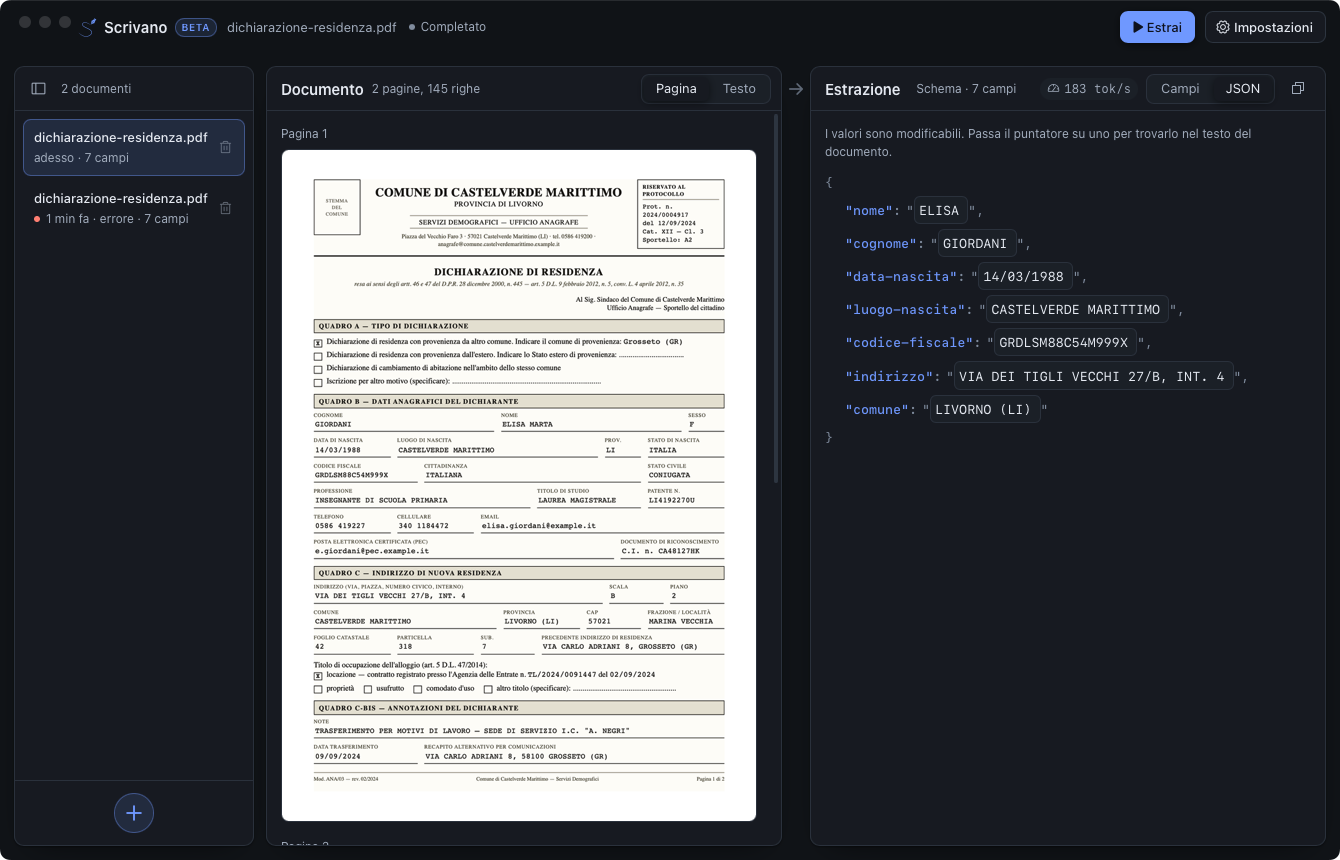 The app with the sample residency declaration loaded: fields on the left, streamed JSON on the right.
Everything is open: app and code, model, GGUF and dataset are on GitHub and Hugging Face 🤗
How it works
The flow is deliberately boring, which is the point:
- Read the page. It accepts
pdf png jpg jpeg webp tif tiff. PDFs render at 200 DPI; a page's own text layer is used when it yields more than 50 characters, otherwise it falls back to OCR (PP-OCRv5 + Latin recognition[1], all Rust/ONNX, no Python at runtime). - You declare the fields. Each field is a
key+ a natural-languagedescription. New documents start from a 7-field preset, because the model was fine-tuned on prompts averaging seven fields. - The model extracts. It streams the JSON, points each value back to where it sits on the page on hover, and flags values that appear nowhere on the page as likely inventions. Decoding is configurable; temperature is 0 by default.
One honest caveat baked into the design: the published accuracy assumes the model is told which fields the document actually contains — you supply that by keeping the schema tight. This is a 350M model. Read the output, don't trust it.
The model
The brain is LFM2.5-350M-IT-Extract:
LiquidAI/LFM2.5-350M[2] fine-tuned with SFT (TRL[3])
to take a document's text plus a field schema and emit a JSON object, omitting fields it can't find.
For the app it is quantised to Q4_K_M — that is the 219 MiB GGUF
that gets bundled and never phones home.
Picking a 350M base was the whole game: small enough to ship inside an installer and run on a CPU, big enough to learn the shape of the task. As with a lot of small-model work, the model isn't learning to read Italian — it's learning to be disciplined: find the value, put it under the right key, close the brace.
The dataset
There was no off-the-shelf Italian KIE dataset shaped like this, so I built one: xfund-kie-it, a conversion of the Italian split of XFUND[4] (a multilingual form-understanding benchmark) into a schema-to-JSON extraction task.
The conversion pipeline starts from 4,882 question→answer links in the Italian XFUND split, maps
labels to a controlled set of keys (2,757 survive, 56%), then drops multi-answer labels and
conflicting duplicate keys. What comes out is 199 documents, 1,461 fields,
37 extraction keys with natural-language descriptions — things like codice-fiscale,
nome-completo, data-nascita, iban — split 149 train / 50 validation.
Small, and I won't pretend otherwise: 149 training documents is a first pass, and it shows.
Does the fine-tune work?
Measured on the 50-document Italian validation split, greedy decoding:
| Model | Avg F1 | JSON parse failures |
|---|---|---|
LiquidAI/LFM2.5-350M (base) |
0.2877 | 6 / 50 |
LFM2.5-350M-IT-Extract |
0.6639 | 10 / 50 |
| same, Q4_K_M GGUF | 0.6635 | 10 / 50 |
| same, Q4_K_M on the app's own OCR text | 0.5662 | 10 / 50 |
Three things fall out of this table:
- Fine-tuning more than doubles F1 (0.29 → 0.66) on 149 documents.
- Quantising to Q4_K_M is essentially free (0.6639 → 0.6635) — the thing you actually ship is the thing you measured.
- OCR costs about 0.10 F1. The clean-text number is what the model can do; the ~0.57 is what you get end-to-end once the pixels have to become text first.
And the part I insisted on in the README: these are upper bounds. The schema is oracle-filtered,
parse failures are excluded rather than scored zero, and the metric double-counts a wrong value.
Everything is reproducible with uv run main.py.
Shortcomings
It's a beta, and the honest list is short:
- First fine-tune on 149 documents → very sensitive to the schema descriptions. Edit those before blaming the document, and prefer the presets.
- Only single-page Italian extraction is tested.
- JSON isn't guaranteed — 10/50 outputs didn't parse strictly; the app recovers key/value pairs from truncated output rather than crashing.
- A right-looking value under the wrong key isn't flagged.
- macOS builds are unsigned (clear the quarantine once); history is capped at 50 documents.
Conclusions 🎁
Scrivano is small on purpose. The interesting claim isn't the F1 — it's that a useful document extractor now fits in 219 MiB, runs on a CPU, and never sends your form anywhere. Three take-homes:
- Offline is a feature, not a downgrade. For documents especially, "it never leaves the laptop" is worth more than a few F1 points from a hosted giant.
- Small models learn the shape, not the knowledge. The model doesn't know Italian tax law; it learned to find a value and put it under the right key. The OCR and the schema do the rest.
- Report upper bounds honestly. Oracle schema, excluded parse failures, a generous metric — say so, or the number lies for you.
Next on the list: more fine-tuning data, checking multilinguality still holds (Italian stays the focus), a PII pipeline, and document classification.
If you want to point it at your own forms, grab a build from the releases 📝
Happy extracting 🤗
References
PaddlePaddle, "PP-OCRv5", PaddleOCR, 2025 ↩︎
Liquid AI, LFM2 Technical Report, 2025 ↩︎
Hugging Face, TRL: Transformer Reinforcement Learning ↩︎
Xu, et al., "XFUND: A Benchmark Dataset for Multilingual Visually Rich Form Understanding", Findings of ACL 2022 ↩︎